Become a Retrofit Climate Champion
Help our communities to make homes warmer, cheaper to run, and lower carbon.
South West Stirling Climate Action Network
Bringing together communities across South West Stirling to amplify local climate and sustainability efforts.
Membership is free and open to anyone living or working in South West Stirling. Join SWScan to connect, collaborate, and champion community-led green initiatives across South West Stirling.
South West Stirling Climate Action Network
What We Do
SWScan grew from an informal network of people engaged in ‘green actions’ in communities across rural South West Stirling . Today, we’re a registered Scottish Charitable Incorporated Organisation with a clear purpose: to support community-based initiatives across the region seeking to mitigate or adapt to climate change, and to increase, and raise awareness of, environmental sustainability.
SWScan does not duplicate the vital work of Community Councils or Development Trusts. We amplify and support community-based climate action through:
Collaborative communication across member anchor organisations, environment groups and individuals.
Knowledge-sharing events, workshops, and online forums.
Collaborative projects on specific topics, so as to maximise impact through pooling of resources and effective project planning.
Advocate as a united voice for South West Stirling, influencing local authorities and policymakers.
Discover how SWScan brings South West Stirling communities together to drive collaborative climate action - get involved today.
Energy Retrofit
Bring Retrofit Know How to Your Community
SWSCAN is leading a community energy retrofit project to help local homes become warmer, cheaper to run, and lower carbon. The project is building a network of local champions, running engagement events to share practical advice, and working through a steering group to shape next steps. It's part of SWSCAN's wider push on climate action across the area, alongside thermal imaging surveys and biodiversity work.SWScan RETROFIT DEVELOPMENT PROJECTSouth West Stirling Climate Action Network (SWScan) is exploring how local communities can be better supported to improve the energy efficiency of their homes and move towards cleaner heating.
We aren't just promoting retrofit — we're finding out what would make retrofit work locally.WHAT WE'LL BE DOINGTRAIN & SUPPORT LOCAL RETROFIT CLIMATE CHAMPIONS
Recruit and train local volunteers to act as trusted local guides, helping neighbours understand retrofit options and find reliable advice and support.If you are interested in becoming a Retrofit Climate Champion, please see the following role description:LISTEN TO LOCAL COMMUNITIES
Hold engagement events across the participating villages to hear residents' experiences, concerns and priorities, and understand what would give people the confidence to take action.UNDERSTAND LOCAL HOMES & ENERGY NEEDS
Analyse available housing EPC data to build a general picture of local housing energy efficiency, heating types and the potential need for retrofit across our rural communities.CONNECT WITH THE LOCAL SUPPLY CHAIN
Identify local assessors, designers and contractors, understand existing skills and capacity, and explore opportunities to strengthen the local supply chain.LEARN FROM WHAT'S ALREADY WORKING
Research existing community retrofit models and identify local homes that have already made improvements. We'll develop practical case studies showing what can be achieved through fabric improvements, heating, hot water, ventilation and renewable energy.EXPLORE THE POTENTIAL FOR A RETROFIT HUB
Bring together what we learn from residents, housing data and local businesses to assess whether a community-led Retrofit Hub could work in South West Stirling, and what would be needed to make it viable.BY THE END OF THE PROJECT
We will have a clearer general picture of what local households need, what local businesses can provide, where the gaps are, and what could potentially make retrofit easier, more trusted and more accessible locally. The findings will inform a Feasibility Study and Action Plan for the future, while the trained Retrofit Climate Champions, local knowledge, case studies and practical resources will continue to benefit communities beyond the project.
South West Stirling Climate Action Network
The Team
Governed by a volunteer board of local charity trustees, our founding team unites grassroots passion with strategic vision from across South West Stirling to amplify community-driven climate and sustainability action.
Frank Deas
Frank lives in Killearn and leads Sustainable Killearn within Killearn Community Futures Company, applying decades of change management expertise to grassroots climate action. He’s also a key organiser for On the Verge, sowing pollinator patches throughout Stirling to boost biodiversity.
Chelsea McKinnon
Chelsea calls Balfron home and serves on the Balfron Community Council, while also helping run the Balfron Community Orchard. With professional experience across the Forth Valley in food sustainability and orchard management, she’s equally passionate about biodiversity and building resilient, connected communities.
Peter Singleton
Peter is a lifelong sustainability enthusiast who spent nearly 40 years with SEPA shaping Scotland’s approach to sustainable development and climate change. Since retiring, he’s chaired Transition Stirling for five years and co-founded Sustainability Kippen, proving his dedication to local action.
Klim MacKenzie
Klim, based in Balfron, has hands-on experience growing food and designing energy systems—from heat pumps to solar PV. He is passionate about weaving sustainable food and energy solutions into rural life.
Jiveen MacGillivray
Jiveen lives in Buchlyvie and brings over 20 years of supporting communities and businesses, in Scotland and overseas, to find their voice and agree on a shared plan. Whether it’s storytelling, facilitating meetings, or launching new ventures, Jiveen’s knack for connecting people ensures every project gets noticed.
Richard Boddington
Richard lives in Drymen. After 20 years working in environmental and renewable energy consultancy he became a house husband and serial volunteer. He is currently the chair of Drymen Community Development Trust where, amongst other things, he runs the cycle meanders and paths group. He also has a keen interest in climate, conservation and canoeing.
Previous Trustees
Wendy Faulkner
South West Stirling Climate Action Network
Contact Us
South West Stirling Climate Action Network
Documents
A growing library of downloadable plans, reports and toolkits, so you can quickly find, read and use the resources that matter most.Click the links below to view and download a document.
We’ve published our first set of annual accounts to give everyone across South West Stirling a clear view of how we’re looking after our resources in this early stage. Sharing these figures reflects our commitment to openness and good governance as the network grows. All foundations we’re putting in place for future community led climate action.
Discover the Local Place Plan - a roadmap for climate action rooted in our communities. Proven, practical solutions from South West Stirling and beyond, offering clear, inspiring steps we can take together to protect nature and tackle climate change head-on. Download it now and be part of shaping a more sustainable future.
Energy Retrofit Hub - to accelerate the adoption of energy efficiency and low-carbon heating in their community. The community survey reveals a strong local desire for retrofit, driven by the need to reduce energy bills, address environmental concerns and create warmer homes. However, significant barriers have also been identified.
Curious how the South West Stirling Climate Action Network puts members at the heart of every decision? Our constitution, established as a Scottish Charitable Incorporated Organisation (SCIO), sets out free membership open to residents, students and organisations across rural South West Stirling, a democratically elected Board of Charity Trustees, and transparent processes including annual general meetings. It’s the guide that ensures every initiative supported is governed with accountability, inclusivity and a shared commitment to meeting the challenge to our climate. Click the link to read the full constitution and discover how you can play an active role in shaping our sustainable future.
South West Stirling Climate Action Network
Join
Membership is free and open to anyone living or working in South West Stirling who wants to see positive climate action in our region.Please fill in the form below. Our Privacy Policy at the bottom of this page tells you what we do with the data you share with us.We welcome:
Individual residents
Community Councils
Development Trusts
Environmental Groups
Other Community Groups
Tap into the power of collaboration:
Build mutual support for climate and sustainability actions in every village.
Share knowledge, skills and ideas, learning what really works.
Promote each other’s initiatives to a wider audience.
Pool resources for regional projects, from active travel schemes to energy retrofit.
Advocate as a united voice for South West Stirling, influencing local authorities and policymakers.
South West Stirling Climate Action Network
We do not list Individual members on our website.
Member Organisations
COMMUNITY COUNCILS
DEVELOPMENT TRUSTS
SUSTAINABILITY GROUPS
Membership is free and open to anyone living or working in South West Stirling. Join SWScan to connect, collaborate, and champion community led green initiatives across South West Stirling now.

First AGM & Networking Meeting - 29 March 2026
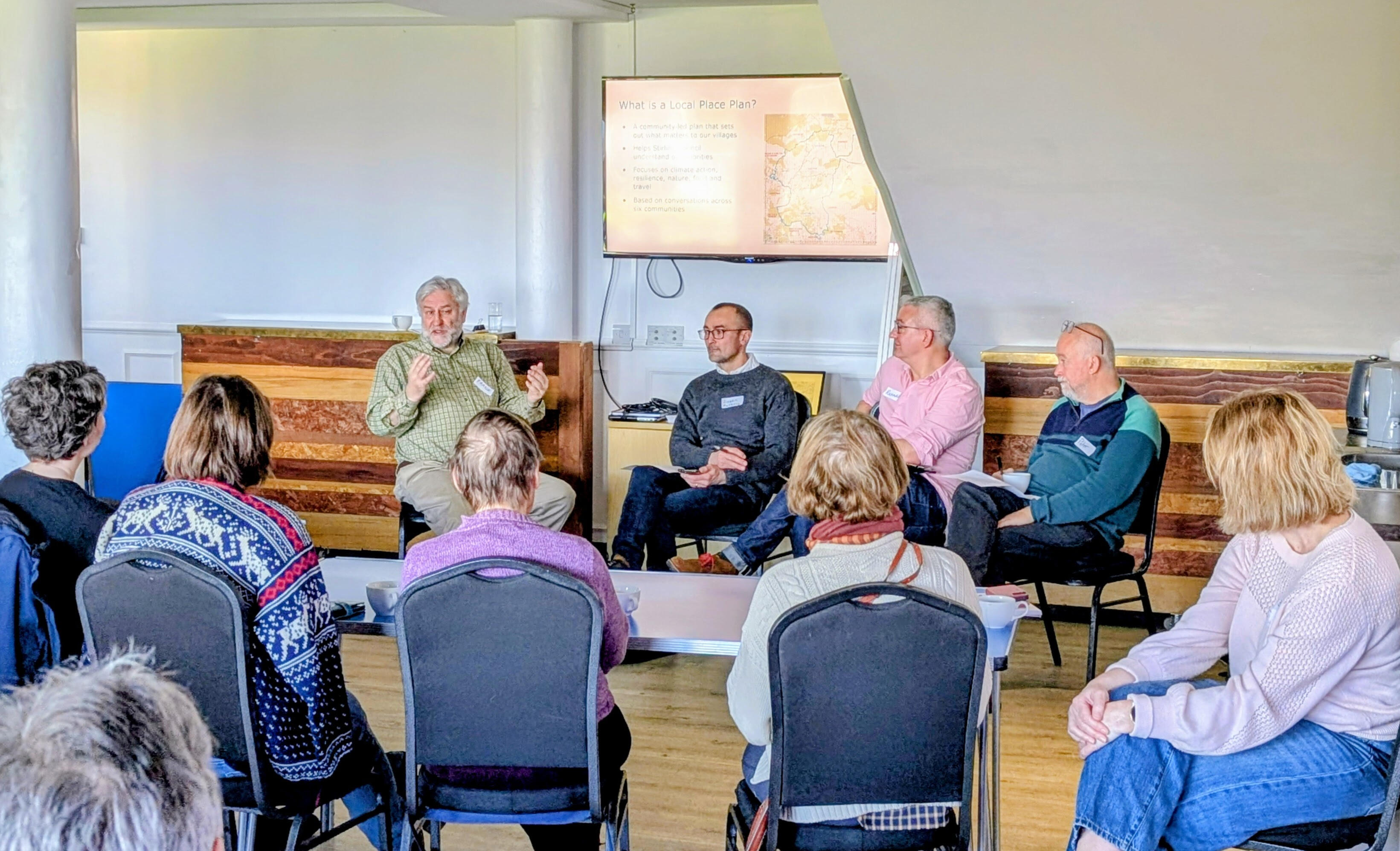
Dear friends and fellow members of SWScan,
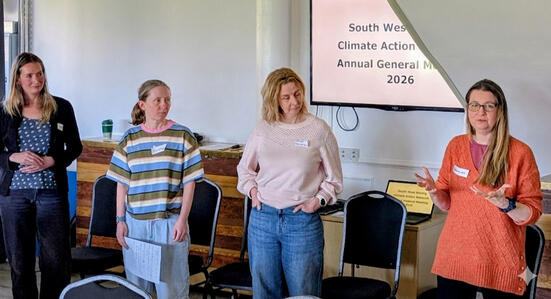
Many thanks to everyone who helped organise and/or took part in our first AGM and networking meeting in Killearn Village Hall on 29th March 2026.
It was a genuine pleasure to gather together, and this page gives an overview of both the formal AGM business and the rich discussions that followed.
Formal AGM business
The meeting was declared quorate by the Chair, who welcomed the 31 members present and asked for their support during the procedural aspects of the AGM.The Chair then gave a report on the previous year’s activities.
The Treasurer presented the accounts for consideration and invited questions. Members approved the accounts and approved the trustees’ appointment of the independent examiner.
As mandated in our constitution, all seven trustees stood down. Six of them — Chelsea McKinnon, Frank Deas, Jiveen MacGillivray, Klim Mackenzie, Peter Singleton and Richard Boddington — offered themselves for re-election and were reappointed for the following year.Wendy Faulkner, one of our founding trustees, did not offer herself for re-election, citing her commitments to MacLaren Community Futures (MCF). The trustees warmly thanked Wendy for all her work in helping SWScan get established and looked forward to continuing to work with her as SWScan and MCF collaborate on rural climate issues.
The Chair’s report and full details of the accounts can be found in the OSCR annual submission on the Documents page of this website
Networking meeting – moving from formal to practical
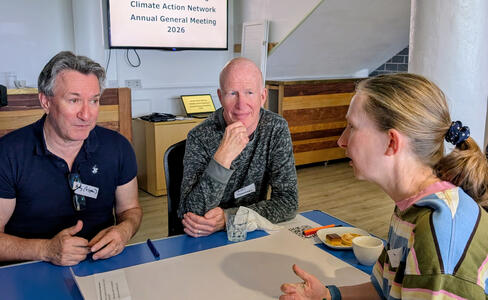
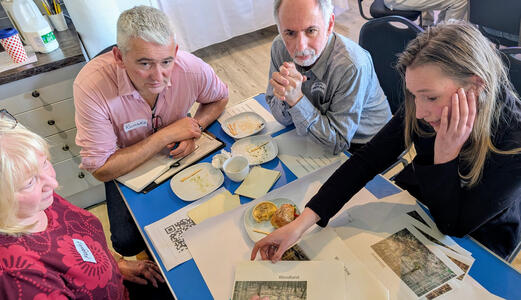
Having completed the formal business, the meeting transitioned into lively group discussions on key sustainability themes, facilitated by local experts:
Energy / Retrofit – Natasha Houchin, Killearn Community Council
Resource – Donna Wood, Transition Stirling
Biodiversity – Mirte Greve, Strathblane Community Development Trust
Engagement / Awareness – Susan Gardner, Sustainability Kippen
While the key points from each thematic discussion are summarised below, it was striking how certain threads ran consistently across all four conversations:
There is already excellent local work on climate and nature underway in many of our communities.
Generating wider awareness of this work would be of real value to everyone — whether as peer support and information exchange for existing initiatives, or to provide ideas and possible approaches for communities just beginning to engage with a particular strand of activity.
Energy
Core conversations centred on generation and retrofit.

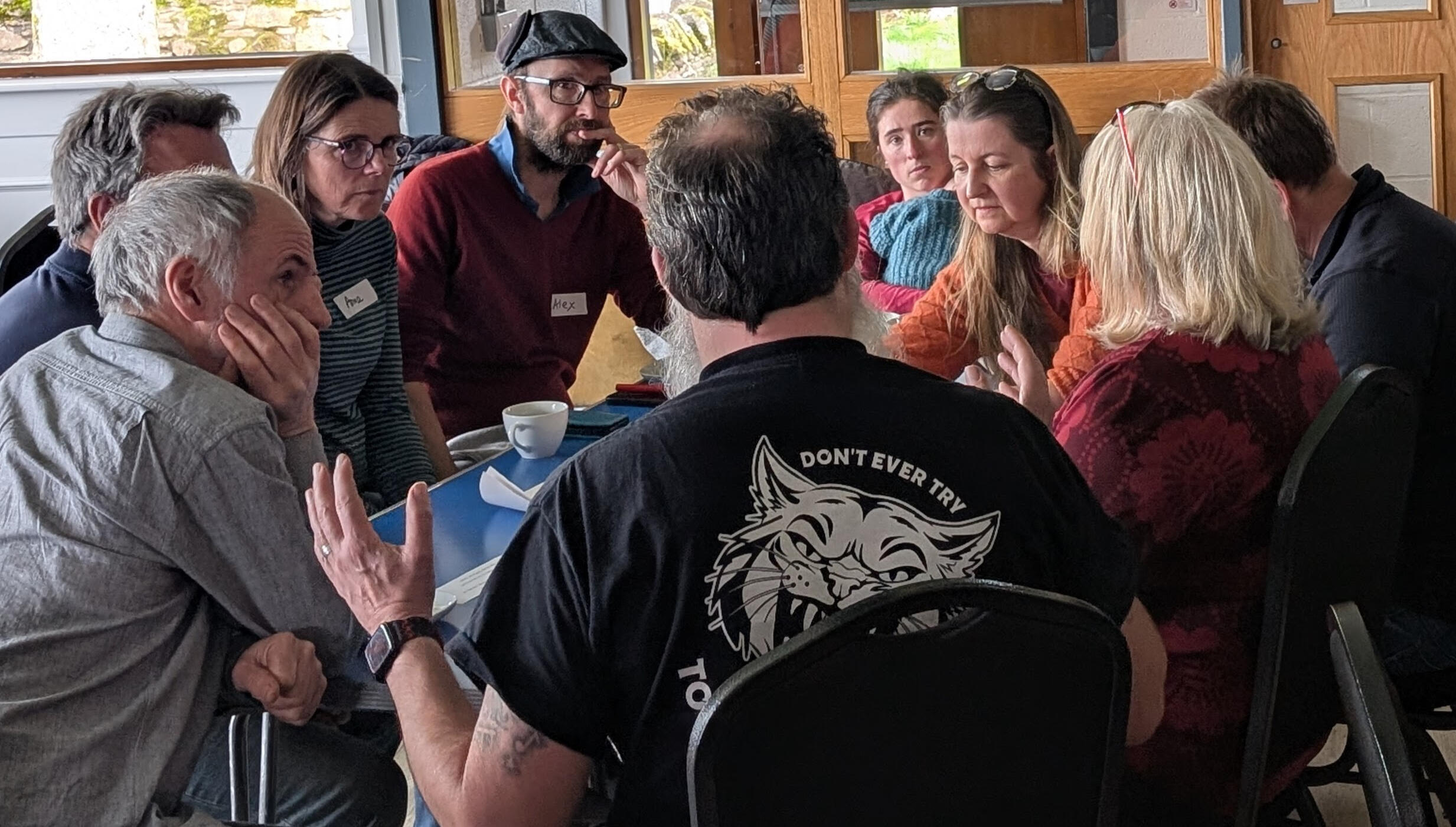
Natasha Houchin, Killearn Community Council; facilitating energy discussion
Community generation
Rural areas offer real opportunities for local generation schemes. Fintry pioneered wind-turbine generation. Balmaha and Strathard both have run-of-river hydro schemes. Drymen and Strathblane are investigating community energy schemes. While it can take three to four years for a local scheme to start paying out a community benefit, the development of Local Energy Clubs should open opportunities for communities to begin purchasing clean local energy at a reduced tariff.Projects tend to be site-specific and rely on local engagement, so a single generic strategy across the region is less realistic. However, it should be possible to create useful case studies of what has worked, and to signpost sources of support (Community Energy Scotland, FEL) and potential funding — a practical route map for villages wanting to move forward on generation.
In addition to directly community-operated schemes, there may be community-benefit funding from wind, solar or hydro schemes adjacent to communities. While it is up to each community how it shares this funding, there are many examples of it being used to support energy-efficiency improvements in local housing and community buildings.
Buildings and energy retrofit

Susan Gardner, Sustainable Kippen; facilitating awareness _ engagement discussion
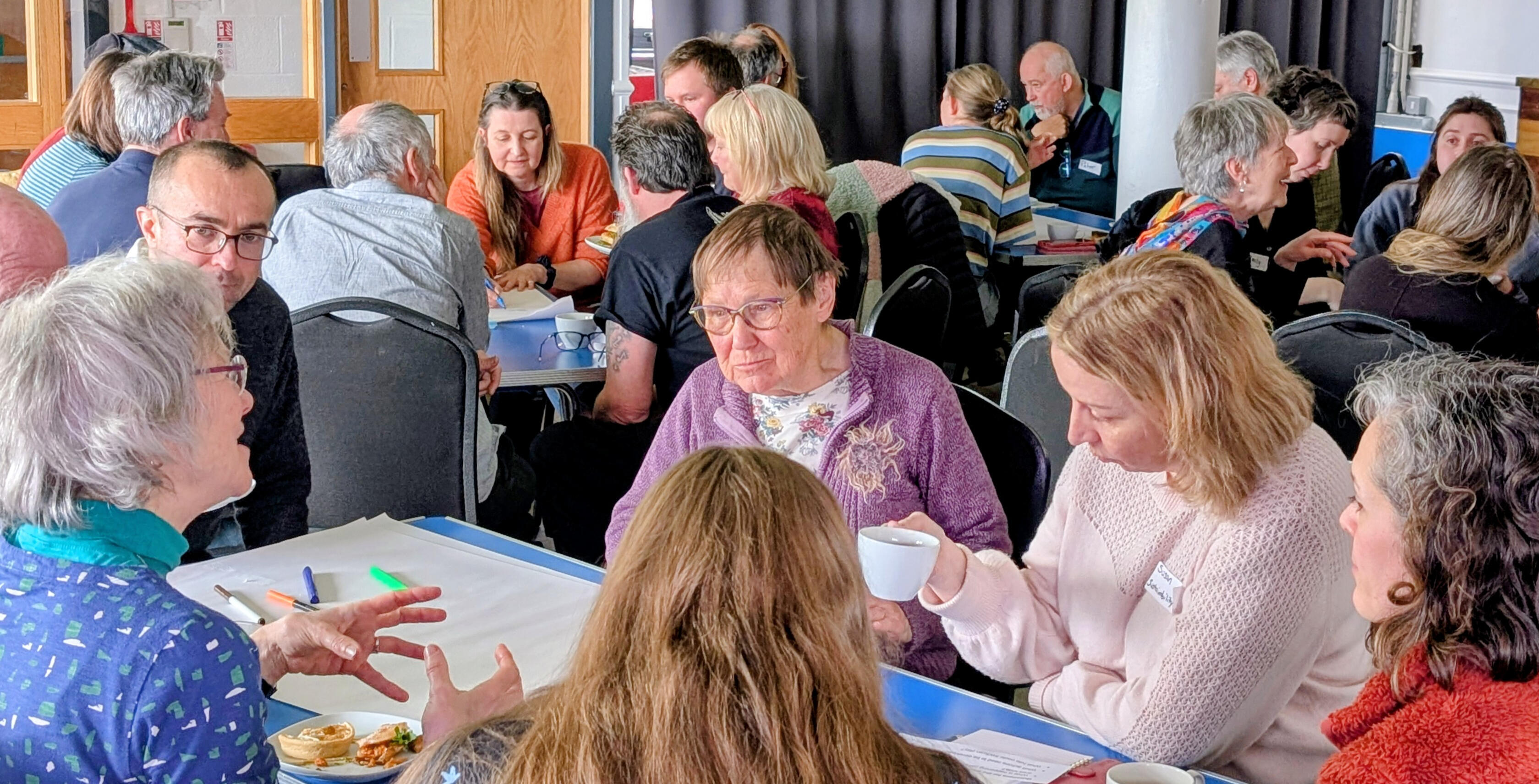
Many of our properties (both housing and community buildings) are expensive to heat. Some still rely on coal with back boilers for hot water. Kippen has no gas, so a lot of oil is used for heating and hot water.An earlier SWScan retrofit survey showed widespread interest in a fabric-first approach — both for potential savings and to ensure healthier, warmer homes and lower carbon footprints. However, there was a lot of uncertainty about what to do and how new technologies worked. While accurate information sources and reliable contractors exist, it can be very hard to identify them or to know who can be trusted.A retrofit hub could give trusted advice — helping local people understand options and providing somewhere they could go to or contact. The funding landscape continues to evolve, so up-to-date information on grants would be extremely useful. While many households might be categorised as “able to pay”, those in lower council-tax bandings or using inefficient heating (such as solid fuel) may still be eligible for support.As part of the journey towards a retrofit hub, it would be good to train up volunteers in each community who could act as local champions — increasing awareness and signposting reliable support and information sources.
Technological improvements and cost reductions in both solar PV panels and local batteries have led to significant increases in micro-generation solutions. While rural areas can make local heat networks difficult to implement, some linked local micro-generation initiatives are being developed. It will also be important to ensure that localised projects are configured to provide increased resilience in the face of main-grid power outages.
Resource

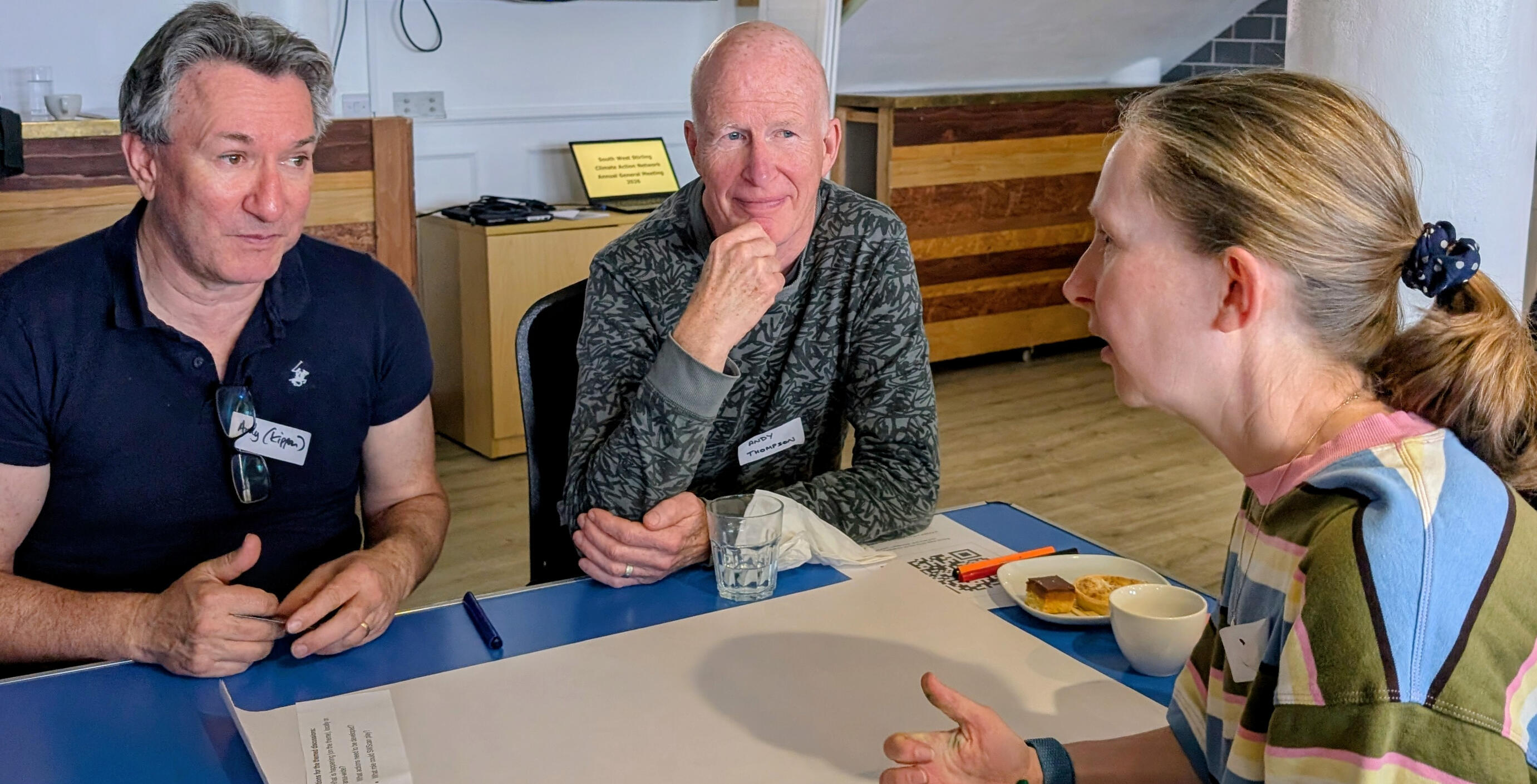
Donna Wood, Transition Stirling; facilitating resource discussion
Reuse
There are already good examples of increasing reuse in rural villages — from Facebook Marketplace and Freecycle through to village Facebook groups or individual housing-development WhatsApp groups. People post items they no longer need which are then reused within the community. Some charities and volunteers also use village Facebook groups to appeal for particular items (warm coats, bicycles), which are then gathered and redistributed where most needed.The nearest main reuse hub is in Stirling, operated by Transition Stirling. It offers a wide range of pre-loved items and accepts donations (do check donation times before heading in).
Tool library
Transition Stirling also runs a Library of Things offering tools and equipment across many categories. Apps such as Lend Engine, Peerby and MyTurn could facilitate more local lending solutions without the need for central warehousing or staffing. Micro-localised schemes covering one or two streets and enabled by a WhatsApp group can be very successful for sharing ladders, platforms, hedge-trimmers, scarifiers and the like.
Repairs
The cost of repairs is sometimes higher than the original product cost. Buying decisions therefore matter: choosing a Fairphone or Framework computer, for example, supports modular design and refurbished supply chains.Local experience of establishing a repair café has been mixed. Stirling Council is potentially going to trial kerbside pick-ups for appliances and small electricals in rural areas. While this should increase recycling, there is an increased risk that repairs get missed out of the resource-management journey.
Balfron Amenity Site
The proposed redevelopment of the Balfron Amenity Site could offer significant opportunities for new resource-management initiatives. Working with Stirling Council, it may be possible to establish a resource centre and a makers’ hub within the new facilities. It will be important to identify which waste streams offer the greatest impact and/or commercial opportunity for reuse, repair or repurposing.To be successful, such an initiative would probably need a paid staff member. There are, however, a number of ways funding might be accessed or operating costs reduced — from environmental grants to charitable rent funding. Transition Stirling could share its own learning, and there could be potential for a hub-and-spoke approach linking a Balfron operation to the main Reuse Hub in Stirling. The same model could also help develop a localised solution for house clearances.
Biodiversity

Mirte Greve, Strathblane Community Development Trust; facilitating biodiversity discussion
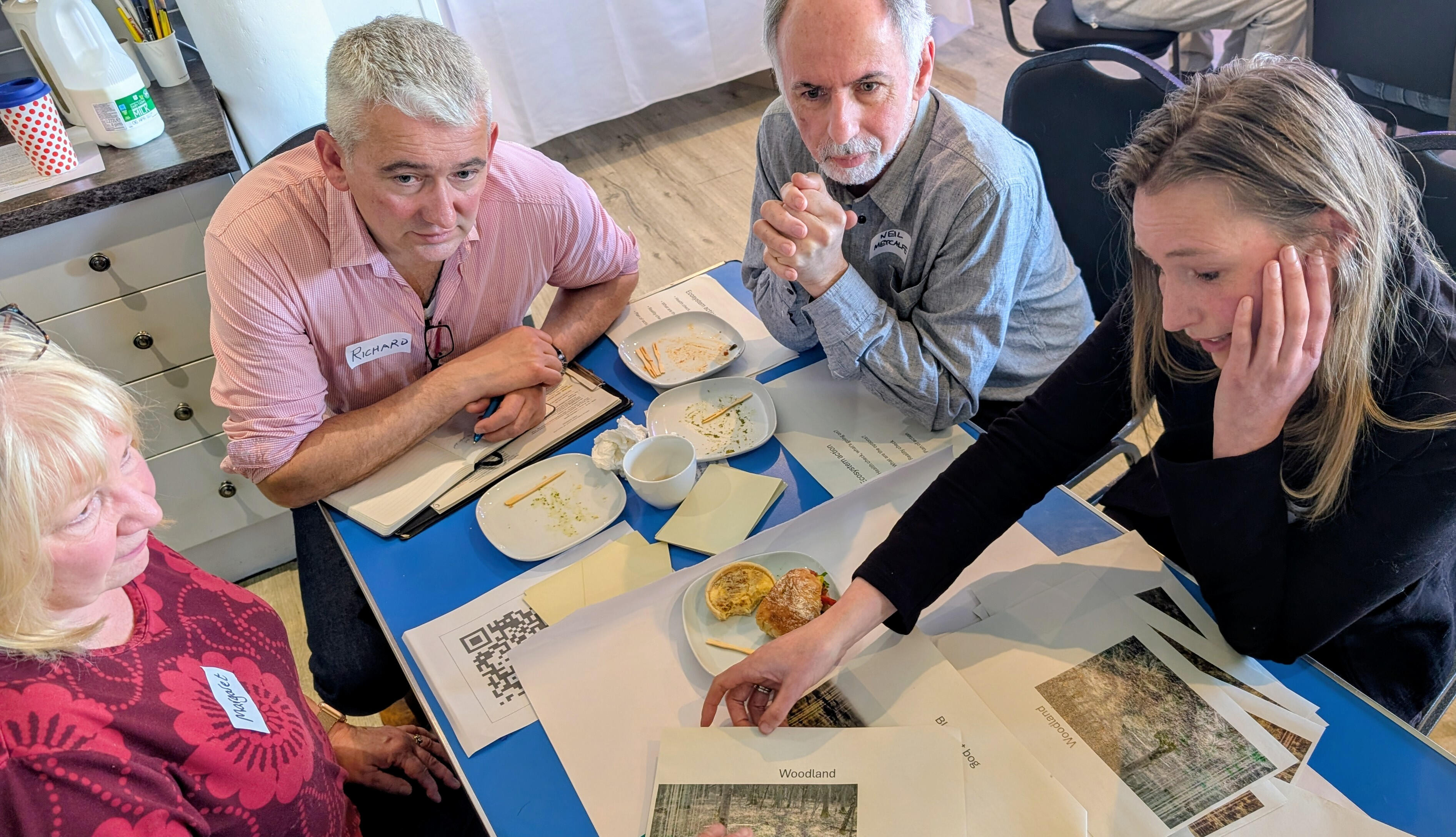
Local Place Plans tend to be community- or village-focused, yet biodiversity and nature often sit “beyond” the village. This is exactly where a broader organisation with a Local Place Plan covering a larger area can add real value — ecosystems do not stop at community-council boundaries.
Habitat types
To help us understand what we need to do to help nature flourish, we can think in terms of broad habitat categories. This both raises awareness of the different types and focuses attention on the interventions that are needed:
Blanket bogs – block peat grips and raise the water level to protect wider areas.
Woodland – reduce deer numbers to ease grazing pressure and allow understorey and young-tree growth; plan woodlands to avoid monocultures and encourage a range of tree ages.
Species-rich grassland (SRG) – identify and record locations (satellite images can help). These are already significant carbon sinks; they are not suitable for climate-forest expansion and need a level of grazing to prevent reforestation. Bracken remains an ongoing threat — an invasive native species whose toxicity means neither sheep nor cattle will graze it, though stock can help trample it. If the SRG can be classified as an SSSI there may be funding for clearance; otherwise it can become a community project.
Moving from extractive to protective
There is a clear need to shift to a new paradigm in our relationship with nature. We need to recognise all that nature does for us and ensure we are doing all we can for nature in return.
What does nature do for us?
Prevents flooding / raises the water table
Provides space for leisure, outdoor activity and tourism
Supports mental health and wellbeing
Reduces the impact of global warming
Nature does EVERYTHING for us!
Is fundamental to our survival — food supply, energy, water, clean air
Delivers carbon sequestration and environmental restoration
What do we need to do to help that happen?
Allow nature to help us — give it space (e.g. for Natural Flood Management)
Communicate with others and spread the word on the importance of nature and how people can help; make people aware of local biodiversity
Share easy, practical steps people can take locally
Work together and share learning on improving local habitats
Develop a land-use plan based on regenerative practices
Approach landowners about wildflower sowing, bird and bat boxes
Monitor impacts — “Guardians of the river”, citizen-science projects, biodiversity measurement
Stop being extractive and viewing nature purely as a resource to exploit
Protect local biodiversity (areas of special protection, River Endrick and Blane Water, blanket bog at Balglass / Campsies)
Protect woodlands and trees locally, but plant the right trees in the right places — do not sweep away existing habitats with inappropriate planting
Support our peatlands, rivers, woodlands, wetlands
Support pollinators and plant wildflowers
Advocate for biodiversity under threat; consider planting that actively encourages biodiversity
Control invasive species
Grow organic food and protect our soils
Optimise people’s gardens and offer guidance; invest in biodiversity
Engagement and Awareness
All projects rely on engagement with, and support from, the communities of which we are part. There are real challenges in winning that engagement — and also a number of ideas and actions that have already proved successful. None is a silver bullet, but they can be effective, especially when used in combination.
Challenges
Reaching people of all different ages
Getting the language right (e.g. “climate” can be a turn-off for some)
The enormity of the tasks and the resulting feelings of being overwhelmed or anxious
Volunteer capacity (“when you are already flat out”)
What has worked? … lessons from experience
Start a group with people who are already interested — build a local team you can work with. Climate/nature action can’t be carried by one person!
Go to where people are; don’t expect them to come to you. Appeal to different demographics. Use existing groups and people’s passions. Work with schools for teenagers.
Make it fun and manageable. Kippen’s launch event included free beer! Take young children to the river to see and understand habitats; experience the dawn chorus (Killearn); get children to sow wildflower meadows (Strathblane).
Address co-benefits to engage people in climate/nature actions and/or get messages across: a community larder that reduces food waste (measurable positive change); retrofit energy-efficiency measures that can engage “new” people and prompt conversations about energy use and carbon emissions.
Create opportunities to talk about climate/nature when people are already engaging through co-benefits or doing something practical (community gardening, conservation volunteering).
Community building is essential. Showing up in person matters. An “ultra-local” focus plus shared learning works.
Have a “hook” that brings the community together — orchard open days, apple-pressing events, visible “buy-in” for community projects (e.g. renewables) that bring funding.
Make full use of available expertise, support and funding (FEL, SWScan, Fresk, funding bodies, expertise already in your village) to ease volunteer capacity and the sense of enormity.
Look for “multiplier effects” — one-off events are rarely sustainable on their own.
Communication is vital. Use all different channels. It takes time and concerted effort.
Thank you again to every one of you who came along, contributed ideas, asked questions, and made the day feel so productive and hopeful. The energy in the room was exactly why SWScan exists — to connect, amplify and support the excellent work already happening across our communities.
If you would like to get more involved, share something that is working in your village, or simply stay in touch, please do join us (membership is free) or drop us a line via the Contact page.
Looking forward to the next chapter together.Warm regards,
Frank Deas
Chair, South West Stirling Climate Action Network
On behalf of the trustees
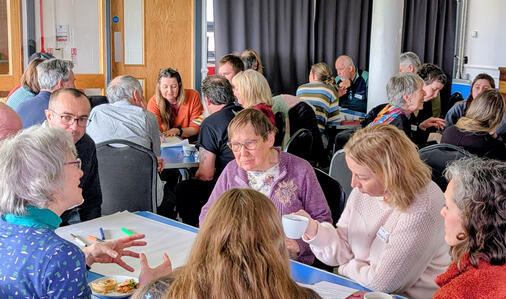
Networking Event & AGM
Killearn Village Hall
Saturday 28th March 2026
In-Person Event
10.00 – 12.30 (including a brunch!)

By collaborating and networking across our communities, we can increase our combined impact on climate change and sustainability.SWScan warmly invites you to this first gathering of your local climate action network! This is an exciting opportunity to:
Meet like-minded folk from other communities
Share local actions, learning, ideas and plans
Start working together to make a positive difference in SW Stirling
The event will include:
AGM, to hear a brief update on last year’s activities and consider next steps for the network.
Action-focused discussions, facilitated by local experts in Energy, Biodiversity, Resource and Engagement.
A splendid brunch!
Everyone passionate about the environment is welcome. Don’t miss out on this friendly gathering to build local climate action.